
Gateshead Council refuses to commit to new target date for 'really, really complicated' demolition of flyover

Gateshead Council has refused to commit to a new target date to complete the removal of the town’s crumbling flyover.
The A167 Gateshead Highway flyover has stood empty since it was shut due to serious safety fears in December 2024 and is scheduled to be demolished.
Council leader Martin Gannon had previously pledged in March last year that the crumbling concrete structure would be gone “within a year”.
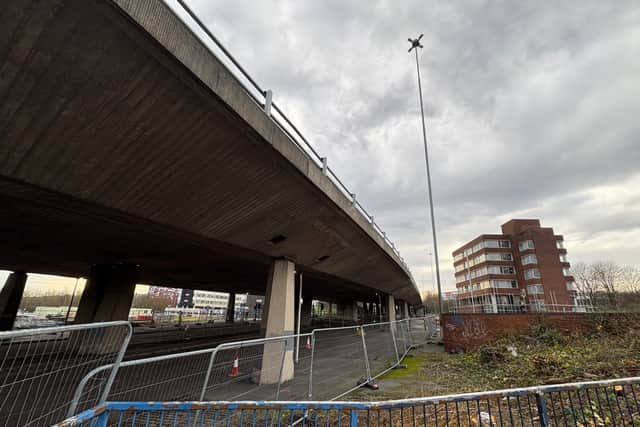

However, bosses announced last week that its demolition will not be starting until this March at the earliest once the neighbouring Computer House offices are torn down.
And local authority officials were reluctant to predict how long it will take to completely remove the flyover, which it is hoped can act as a catalyst for ambitious town centre regeneration plans, when grilled by councillors on Monday morning.
Anneliese Hutchinson, the council’s strategic director for the economy, innovation and growth, told a Civic Centre scrutiny panel that the demolition was a “really, really complicated” project due to the design and location of the flyover, in the centre of a town and above underground Metro tunnels.
She reported that bespoke props are now being manufactured to keep the structure safe during the demolition, with further surveys and preparatory works planned while contractors are completing their job on Computer House.
It is then expected that people will see the flyover gradually coming down “from April, May onwards”, starting with its central section.
Ms Hutchinson added that no firm end date could be set for the project yet, until the demolition begins in earnest and engineers discover how it comes down, but that Gateshead was working faster than had been seen in similar situations elsewhere – saying that the average time taken for such a scheme would be around four years.
Ron Beadle, leader of Gateshead’s Lib Dem opposition, questioned why the council had previously suggested the flyover could be demolished within a year, saying that “raising expectations is not a way to communicate properly on behalf of the council”.
Coun Beadle added: “Given what we have heard about the centrality of this removal to the opportunities provided to regenerate Gateshead, should we not have been doing this ourselves years ago?”
Ms Hutchison replied that previous targets came with “an awful lot of caveats” and that it was “impossible to judge exactly how long it is going to take”.
Coun Gannon said: “It was perhaps ambitious even then to say we could get it down within a year. Do I regret saying that? Yes I do. It is a lesson learned. But it is not a lesson that is going to be repeated [because] we don’t have many structures of this sort of scale.”
He added that his previous comments had “turned something positive, that something that should take four years is being done in 18 months, into a negative”.
Councillors were told that the expected cost of the demolition is not yet known and a contract with BAM Nuttall for the works has not been finalised. The council has set aside £18 million and a further £2.5 million has been contributed by the North East Combined Authority.
Coun Beadle also asked if a post-tensioned special inspection (PTSI) of the flyover’s steel cables should have been conducted and what difference that might have made, after the BBC reported that such an inspection had not been carried out for 28 years prior to its closure.
Council officers replied that the study would have come at a substantial cost and been of “quite limited” value, as other checks were already being carried out and the purpose of a PTSI would have been to identify specific areas to invest more money to improve the structure – something the council did not want to do.