
I was a teacher for 17 years & my views on the ban on mobile phones in schools won't be popular with your teen

“But other teachers let us have our phones out in lessons” - one of the irritating sayings I most frequently heard during my 17 year career teaching in secondary schools.
Whilst it may now be around eight years since I was last in the classroom, the issue of mobile phones in schools was already a perennial gripe for staff in all the schools I worked in.

As a child growing up in the 80s and 90s, to carry a mobile phone into school would have required a separate bag to accommodate it.
However, to most teenagers today, a mobile phone is almost an extension of their very self, offering a place of perpetual connection to friends and offering an immediate source of entertainment.
The personal nature and content of a mobile phone makes it something anyone would rather not hand over, let alone a hormonal teenager.
I remember several stand-offs with students refusing to hand over their mobile phones despite clear rules being in place not to have them out in lessons.
Whilst I knew for the most part students referencing the fact my colleagues allowed them to have their mobile phones out was incorrect, I was also aware of the odd occasion I had seen this to be true.
The slightest inconsistency in applying the rules can ultimately undermine their implementation, leading to inevitable conflict between staff and pupils.
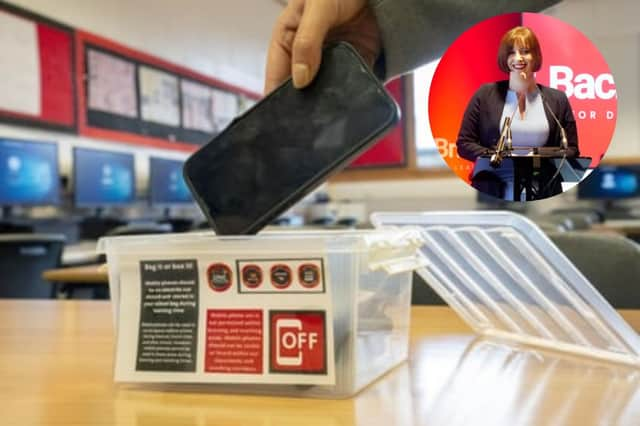
This is why I overall welcome the education secretary's stance in writing to headteachers this week with a directive that “mobile phones have no place in schools”.
Along with the disruptive impact it can have on learning, I recall many a lunchtime dealing with the fallout of something being said or posted online causing a meltdown or rift amongst members of my tutor group.
As recently highlighted by the Netflix drama Adolescence there are growing concerns about the negative impact constant access to social media and unfiltered online content can have on young minds.
The policy of schools during my 17 years in the profession was generally that children were allowed to bring phones into school, but they could not be seen or heard in lessons.
Sounds perfectly fine in theory, and as a parent myself I fully understand for safety and security reasons why you want to ensure you and your child are easily contactable.
However, as is the case with all rules, there will always be a number of pupils who will try and push boundaries.
If a phone is in your pocket and you feel it buzz, it’s only natural, even as an adult, to want to check and see what has come through.
The stance taken by Bridget Phillipson removes any ambiguity, and gives consistency and clarity, not just for teachers and pupils, but also for headteachers communicating with parents.
I quickly became aware in my time in schools that for any rules and policies to be successfully implemented you need to have the full support of parents and families.
At least following the education secretary’s letter, headteachers are now empowered with a clear directive from the top which is consistent across all schools.
Within her letter the education secretary specified that all schools should be phone-free environments for the entire school day “including lessons, time between lessons, breaktimes and lunchtime”.
This does still leave scope for pupils to potentially be able to access their phones before the start and at the end of the school day.
However, the only way this would work is if pupils placed their phones in a secure storage area at the start of the school day.
Otherwise, there will always be that temptation to use it, which will once again create the potential to undermine the directive and create the inconsistency it was designed to eradicate.