
I climbed to the top of Grey's Monument and saw a whole new side to Newcastle

I have called the North East home for nearly a decade now, but one top attraction had always evaded me.
Since moving to the region back in 2016 I have made sure to throw myself into what the region has to offer, but for years I have missed out on heading to the top of one of the North East’s most recognisable attractions.
Grey’s Monument, where Grey Street, Grainger Street and Blackett Street meet, is a popular meeting point, speaker’s corner and widely understood to be the centre of the city to many.
But these days not many people are able to head up to the top and see the stunning views on offer so, as part of a trip into the city centre to check out the additions to Grey Street, I got a stroke of luck, saw the monument was open and was able to head up the city centre icon.

Completed in 1838, the site is nearly 200 years old and is a commemoration of Charles Grey, 2nd Earl Grey, Prime Minister of the United Kingdom from 1830 to 1834.
In particular, it celebrates his role in the passing of the Great Reform Act of 1832, which saw major electoral reform including a complete rearrangement of parliamentary constituencies.
The Northumberland-born politician also saw the Slavery Abolition Act passed during his time as Prime Minister, which banned slavery in most of the British Empire, with the exception of territories run by the East India Company.
These days the monument is showing its age slightly, with improvements to the gold text on the side of the site made as time moves on. Opportunities to go up the monument are limited too, with tours up the tower coming to an end in mid October and only starting again in the Spring due to unpredictable weather.
This would turn out to be the final opening of the monument for 2024.
After squeezing through a tiny door at the west side of the monument’s base, it was clear why this would be the final chance to head up this year. A puddle had begun to flood the main opening of the tower with any additional rain surely covering anyone’s feet who would look to make their way up.
Wet feet thanks to non-waterproof shoes aside, the 164 steps passed fairly quickly, and the views at the top were something to behold.
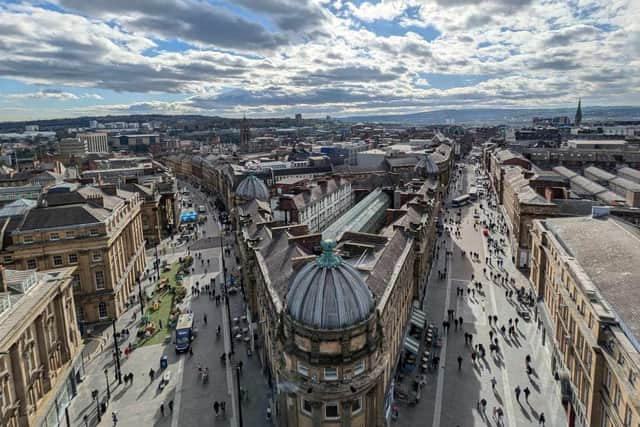
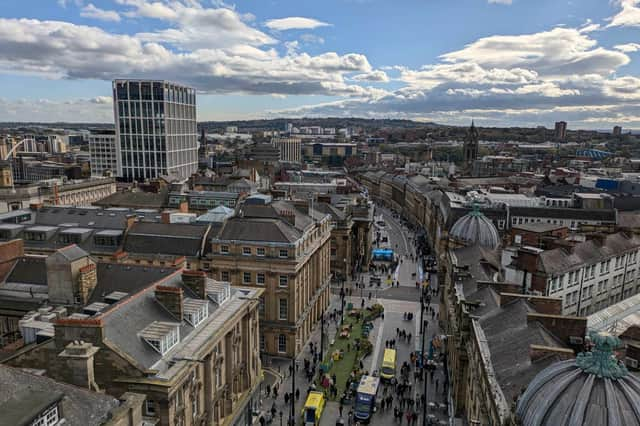
Grey Street and Grainger Street looked like European boulevards working their way towards the Tyne, which was barely visible, even from one of the city’s highest open air viewpoints. Only the Millenium Bridge, Baltic Gallery and High Level Bridge showed where the river flows.
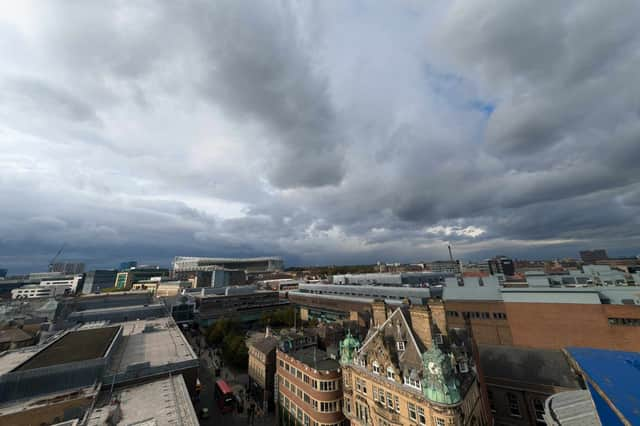
Turning the other way there is only one thing which truly hits your eyeline. Sir Bobby Robson’s description of St James Park as “the cathedral on the hill” had never seemed more apt with the stadium making up so much of the skyline looking over Eldon Square.
Keeping a protective, watchful eye over the city, St James Park is perfectly placed to show what he club means to the city.
With talk of the home of Newcastle United being moved, it is only when you see the stadium from this angle do you see how it makes Newcastle so unique. Plenty of clubs have moved away from city centre grounds across the nation, but the club has remained steadfast in keeping itself rooted to its history and community - and from the top of the monument the development of the city throughout that history is evident.
From the river, up iconic, sweeping roads and over roofs which could easily be as old as the monument itself, St James Park still offers that ‘wow’ factor when observing the city - and losing it’s current form will only give the monument extra prominence as the skyline continues to change as the passage of time relentlessly continues.