
Newcastle Airport accused of 'smoke and mirrors' by campaigners over major expansion masterplan

Climate campaigners have accused bosses of “smoke and mirrors” over plans for a major expansion of Newcastle International Airport.
The airport wants to extend its runway and offer flights to more destinations, under proposals which it says will almost double passenger numbers to nine million per year by 2040 and generate £1.9 billion for the North East economy.
But activists opposing the expansion claim that the economic growth will not outweigh the environmental harm caused by running more flights.
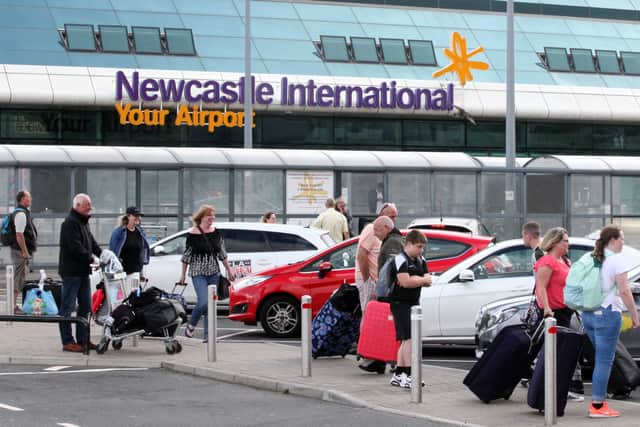

Climate Action Newcastle and the Aircraft Noise Action Group have called on local councils, which own a 51% stake in the airport, to demand “independently validated evidence” that increased flights would sustainably boost the region’s economy and not help “derail the UK’s legal commitments to decarbonise”.
The airport said that sustainability is “at the heart of our plan”, as it seeks to reach net zero emissions by 2035 through measures such as expanding its solar farm and planting new woodland.
However, it excludes emissions from flights taking off and landing from its net zero calculations and only includes factors over which it has more “direct control” – such as heating and electricity for the airport itself, staff commuting, and passenger journeys to and from the airport.
The airport’s 2040 masterplan estimates that its current carbon footprint related to flights is equivalent to more than 51,000 tonnes of carbon dioxide, while all other factors combined produce only 29,000 tonnes.
Olwyn Hocking, of Climate Action Newcastle, said: “We’ve found that economists, academics and aviation experts all expect an uncertain future for aviation and airports. We’d welcome a realistic masterplan that faces up to aviation’s rising contribution to global carbon emissions, but not one that buries the emissions from Newcastle’s current flights on page 83 in small print. That’s in contrast to 27 mentions of “Net Zero”; the “Net Zero 2035” goal applies only to the airport hub, but its prominence suggests the airport thinks a huge increase in emissions from flights doesn’t matter.”
A committee of MPs issued a report last year which found that airport expansions put the UK’s legal commitment to reach net zero by 2050 in “serious jeopardy”.
The cross-party Environmental Audit Committee said that the Government “has not demonstrated that the economic growth from airport expansion provides enough benefit to outweigh the negative climate and environmental impacts it will lead to”.
Roger Haydon, of the climate action campaign’s Stop Flights Doubling steering group, called Newcastle Airport’s masterplan “a lot of assumptions and assertions without sound evidence – smoke and mirrors”.
The North East Public Transport Users Group (NEPTUG) also accused the airport of having “scant regard for the impact this will have on local communities, the environment, and global efforts to tackle climate change”.
NEPTUG co-chair Alistair Ford said the expansion plans also risked causing traffic misery for surrounding communities.
He added: “The plan proposes ‘a number of road infrastructure improvements’ to deal with additional car journeys, a new roundabout on the A696 to cope with more traffic, ‘significant growth in long stay car parking’, a separate access to Prestwick Road, and an additional almost 8,000 car parking spaces at the airport. There is almost nothing in the plan to enable more people to travel by sustainable transport such as Metro and buses beyond vague promises of ‘supporting’ new Metro trains and ‘encouraging’ new bus services. Taken together, this means huge increases in traffic to and from the airport, more congestion, noise pollution, and emissions from passenger journeys.”
The airport masterplan states that it has “limited control over the emissions created by aircraft landing and taking off”, but that it “we must take action to reduce our carbon emissions from flights” and “will continue to work with our airlines to use the latest, most efficient aircraft”.
A Newcastle Airport spokesperson said: “Our 2040 masterplan was shaped by our biggest-ever public consultation, with more than 600 responses from local residents, businesses and stakeholders.
“It sets out a clear vision for the future of the airport, with the potential to serve up to nine million passengers a year, support 5,000 on‑site jobs and contribute up to £1.9bn to the North East economy.
“Sustainability is at the heart of our plan and initiatives such as expanding our on‑site solar farm, creating new woodland areas and transitioning to a fully electric vehicle fleet are all key steps towards us achieving net zero by 2035, something we are on track to deliver.
“The airport’s economic and employment impact was independently assessed by global consultancy Arup, supported by interviews with key partners including airlines, universities and council bodies.
“These findings, presented as part of our Economic Impact Assessment report published last year, received strong backing from more than 40 regional business leaders.
“As the airport continues to grow, we will continue to work closely and engage with local residents, businesses and stakeholders, while further strengthening our role as the North East’s international gateway.”